
Datasets:
input_image imagewidth (px) 1.02k 1.02k | edit_prompt stringlengths 8 32 | edited_image imagewidth (px) 1.02k 1.02k |
|---|---|---|
Place long thin brown hair | ||
Place long brown thin hair | ||
Add thin white long hair | ||
Add brown hair | ||
Place hair | ||
Place long grey hair | ||
Place hair | ||
Add brown thick hair | ||
Place thin grey hair | ||
Add hair | ||
Introduce hair | ||
Add hair | ||
Place thin short hair | ||
Place long hair | ||
Introduce thick long white hair | ||
Introduce thick white hair | ||
Place white hair | ||
Place hair | ||
Add hair | ||
Place hair | ||
Add hair | ||
Introduce grey thick hair | ||
Introduce white hair | ||
Add hair | ||
Add brown thick short hair | ||
Introduce long thick hair | ||
Introduce thick grey hair | ||
Introduce hair | ||
Add grey thin hair | ||
Add hair | ||
Add hair | ||
Place short hair | ||
Place brown thin hair | ||
Place thin short brown hair | ||
Place grey hair | ||
Introduce thin short hair | ||
Introduce hair | ||
Introduce brown hair | ||
Introduce hair | ||
Add hair | ||
Place hair | ||
Introduce hair | ||
Place hair | ||
Add long thick hair | ||
Add long thick hair | ||
Add thick long white hair | ||
Place thin hair | ||
Introduce thin brown long hair | ||
Introduce long grey thick hair | ||
Place grey thick hair | ||
Add white long hair | ||
Introduce brown hair | ||
Add thick hair | ||
Add grey long thick hair | ||
Introduce thick grey hair | ||
Place brown short thin hair | ||
Introduce thick long grey hair | ||
Place thick short grey hair | ||
Place white hair | ||
Add brown hair | ||
Place thin brown long hair | ||
Add long thick hair | ||
Introduce white long thick hair | ||
Add hair | ||
Introduce long thin hair | ||
Place brown long thin hair | ||
Add hair | ||
Place short white hair | ||
Add hair | ||
Introduce white thin long hair | ||
Introduce brown thin long hair | ||
Introduce long thin white hair | ||
Add grey hair | ||
Add white hair | ||
Add brown thin short hair | ||
Place thick short hair | ||
Place thin hair | ||
Place short thin hair | ||
Add grey thin hair | ||
Add hair | ||
Introduce thin brown long hair | ||
Add hair | ||
Place long thick white hair | ||
Place long brown thick hair | ||
Add white thick hair | ||
Place thin brown hair | ||
Add thin grey hair | ||
Introduce thin grey hair | ||
Add hair | ||
Introduce thin hair | ||
Introduce hair | ||
Place thick long grey hair | ||
Introduce hair | ||
Introduce hair | ||
Introduce white hair | ||
Introduce short grey thin hair | ||
Place white short hair | ||
Introduce thin white hair | ||
Place thin short grey hair | ||
Introduce hair |
S-SYNTH
S-SYNTH is an open-source, flexible skin simulation framework to rapidly generate synthetic skin models and images using digital rendering of an anatomically inspired multi-layer, multi-component skin and growing lesion model. It allows for generation of highly-detailed 3D skin models and digitally rendered synthetic images of diverse human skin tones, with full control of underlying parameters and the image formation process.
Framework Details
S-SYNTH can be used to generate synthetic skin images with annotations (including segmentation masks) with variations of:
- Hair artifact
- Blood fraction
- Lesion shape
- Melanosome fraction
- Sample per pixel (for rendering)
- Lighting condition
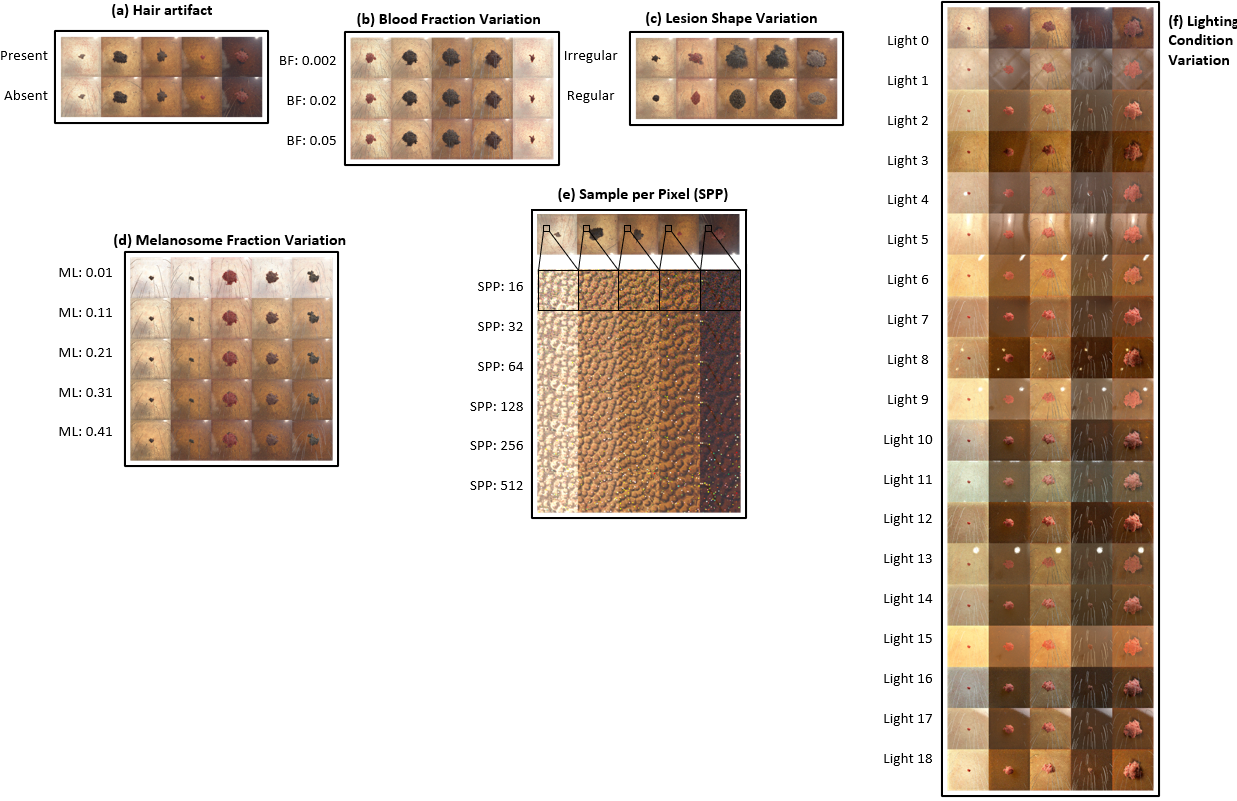
Framework Description
- Curated by: Andrea Kim, Niloufar Saharkhiz, Elena Sizikova, Miguel Lago, Berkman Sahiner, Jana Delfino, Aldo Badano
- License: Creative Commons 1.0 Universal License (CC0)
Dataset Sources
Uses
S-SYNTH is intended to facilitate augment limited patient datasets and identify AI performance trends by generating synthetic skin data.
Direct Use
S-SYNTH can be used to evaluate comparative AI performance trends in dermatologic analysis tasks, estimating the effect skin appearance, such as skin color, presence of hair, lesion shape, and blood fraction on AI performance in lesion segmentation. S-SYNTH can be used to mitigate effects of mislabeled examples and limitations of a limited patient dataset. S-SYNTH can be used to either train or test pre-trained AI models.
Out-of-Scope Use
S-SYNTH cannot be used in lieu of real patient examples to make performance determinations.
Dataset Structure
S-SYNTH is organized into a directory structure that indicates the parameters. The folder
data/synthetic_dataset/output_10k/output/skin_[SKIN_MODEL_ID]/hairModel_[HAIR_MODEL_ID]/mel_[MELANOSOME_FRACTION]/fB_[BLOOD_FRACTION]/lesion_[LESION_ID]/T_[TIMEPOINT]/[LESION_MATERIAL]/hairAlb_[HAIR_ALBEDO]/light_[LIGHT_NAME]/ROT[LESION_ROTATION_VECTOR]_[RANDOM_ANGLE]/
contains image files and paired segmentation masks with the specified parameters.
$ tree data/synthetic_dataset/output_10k/output/skin_099/hairModel_098/mel_0.47/fB_0.05/lesion_9/T_050/HbO2x1.0Epix0.25/hairAlb_0.84-0.6328-0.44/light_hospital_room_4k/ROT0-0-1_270/

data/synthetic_dataset/output_10k/output/skin_099/hairModel_098/mel_0.47/fB_0.05/lesion_9/T_050/HbO2x1.0Epix0.25/hairAlb_0.84-0.6328-0.44/light_hospital_room_4k/ROT0-0-1_270/
├── mask.png
├── image.png
├── cropped_mask.png
├── cropped_mask.png
└── crop_size.txt
Each folder contains two versions (cropped and uncropped) of a paired skin image and lesion segmentation mask. The images were cropped to ensure a variety of lesion size. The crop size is provided within the crop_size.txt file.
The accompanying data can be either directly downloaded, or accessed using the following HF data loader:
from datasets import load_dataset
data_test = load_dataset("didsr/ssynth_data", split="output_10k")
print(data_test)
Bias, Risks, and Limitations
Simulation-based testing is constrained to the parameter variability represented in the object model and the acquisition system. There is a risk of misjudging model performance if the simulated examples do not capture the variability in real patients. Please see the paper for a full discussion of biases, risks, and limitations.
How to use it
The data presented is intended to demonstrate the types of variations that the S-SYNTH skin model can simulate. The associated pre-generated datasets can be used for augmenting limited real patient training datasets for skin segmentation tasks.
Citation
@article{kim2024ssynth,
  title={Knowledge-based in silico models and dataset for the comparative evaluation of mammography AI for a range of breast characteristics, lesion conspicuities and doses},
  author={Kim, Andrea and Saharkhiz, Niloufar and Sizikova, Elena and Lago, Miguel, and Sahiner, Berkman and Delfino, Jana G., and Badano, Aldo},
  journal={International Conference on Medical Image Computing and Computer Assisted Intervention (MICCAI)},
  volume={},
  pages={},
  year={2024}
}
Related Links
- Downloads last month
- 295